

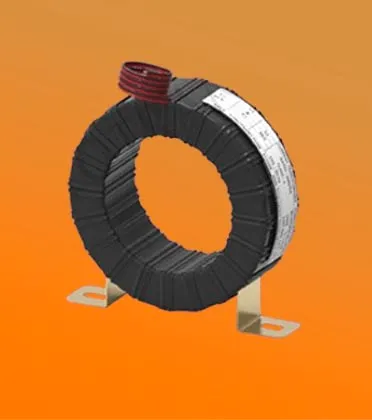
TORO-TW-C Tape Insulated CT
High-precision tape-wound protection current transformer designed for LT switchgear, feeder protection, and heavy industrial busbar monitoring.
In modern low-voltage (LV) electrical distribution, power quality metering, and protective relaying, the Tape Wound Current Transformer (also designated as a tape-insulated or tape-wrapped toroidal CT) represents one of the most electro-mechanically versatile magnetic components available to panel builders and plant engineers. Unlike heavy, rigid cast-resin transformers or plastic-cased modular CTs, a tape-wound current transformer utilizes a high-grade grain-oriented toroidal core wrapped directly with specialized dielectric insulation tapes (such as polyester film, Nomex, crepe paper, or high-tensile fiberglass tape).
From an electromagnetic perspective, the toroidal core geometry of a tape wound CT provides a seamless, jointless magnetic flux path with near-zero air gap reluctance. When wound uniformally with high-purity enamel copper wire and outer-taped for mechanical and environmental defense, this construction delivers superior excitation characteristics, minimal leakage reactance, exceptional accuracy (Class 0.2s, 0.5, 1.0, 5P10, 10P20), and low thermal rise during continuous overcurrent events.
While resin-cast current transformers excel in outdoor high-voltage switchgear requiring solid epoxy dielectric isolation, Tape Wound Current Transformers offer unparalleled dimensional flexibility, reduced total weight (up to 40% lighter), faster custom prototype fabrication, and thermal expansion compliance. For indoor low-tension (LT) switchgear panels, motor control centers (MCC), and retrofitting compact busbars, tape-wound units allow precise custom inside diameters ($I.D.$) and outside diameters ($O.D.$) without requiring costly steel casting molds.
The operating precision of a Tape Wound Current Transformer depends heavily on the core magnetic permeability and the structural integrity of its insulation layers. At Torotrans, our 30+ years of toroidal engineering experience in Pune, India, has yielded optimized core-winding dynamics tailored to specific metering and protection applications.
The core is the heart of any current transformer. We select and precision-slit core materials according to required saturation levels ($V_k$) and accuracy limits:
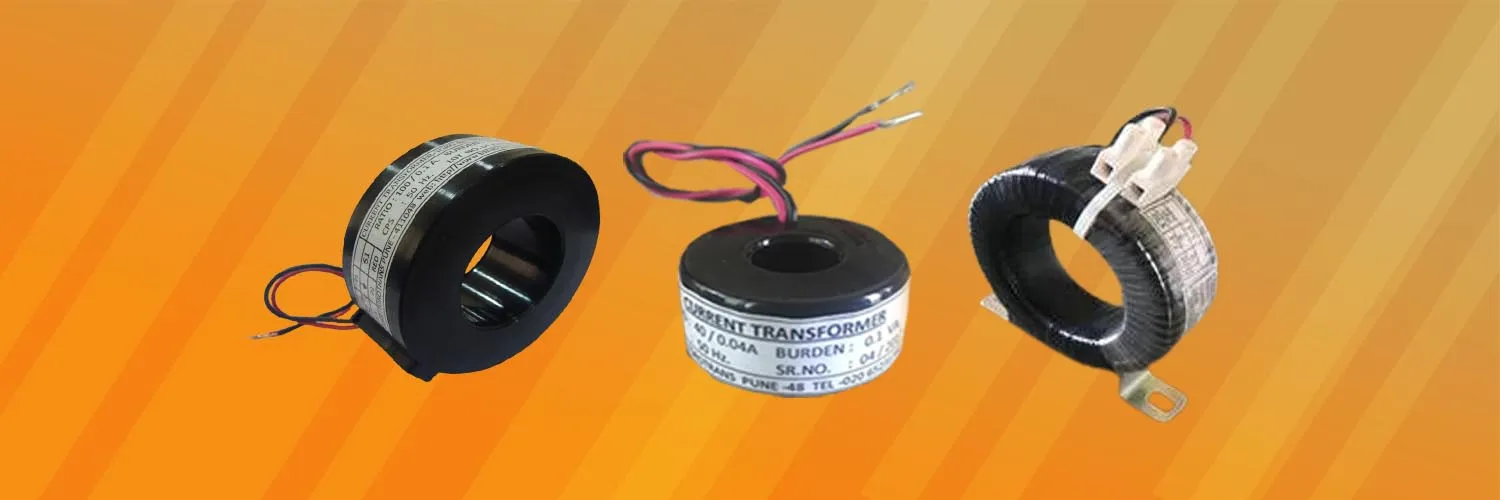
The term "Tape Wound" refers both to the continuous tape-wound core construction and the exterior protective insulating tape wrapping. Depending on operating voltage, thermal rating (Class A, B, F, H), and ambient environment, Torotrans utilizes specialized dielectric wraps:
Standard for indoor Low Tension (LT) protection and measuring transformers. Offers high dielectric breakdown strength ($> 5 \text{ kV}$), excellent tensile resistance, and low moisture absorption for Class B ($130^\circ\text{C}$) operating conditions.
Engineered for high-temperature Class F ($155^\circ\text{C}$) and Class H ($180^\circ\text{C}$) industrial applications. Provides high thermal endurance, zero flame propagation, and superior mechanical tear strength under intense electromagnetic forces during busbar short circuits.
Torotrans manufactures a diverse line of Tape Wound Current Transformers, resin-cast measuring units, and ring-type toroidal CTs engineered for global industrial panels, power stations, and OEM switchboards. Explore our primary models below:
High-precision tape-wound protection current transformer designed for LT switchgear, feeder protection, and heavy industrial busbar monitoring.
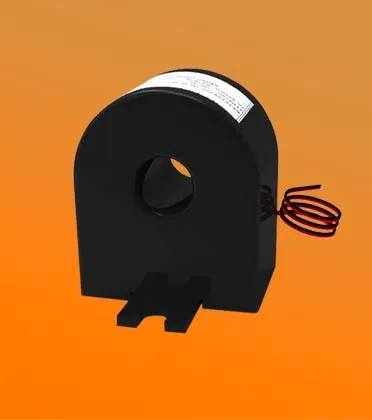
Compact busbar pass-through measuring CT optimized for space-restricted distribution boards and energy meter integration.
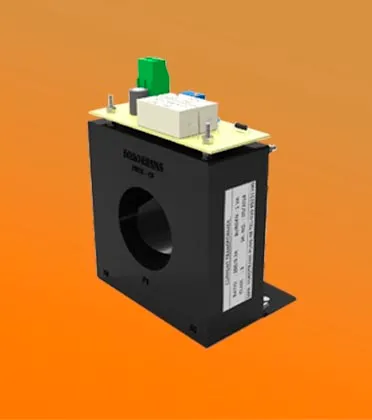
Heavy-duty protection & metering CT featuring multi-ratio secondary taps and high knee-point voltage tolerance for protection relays.
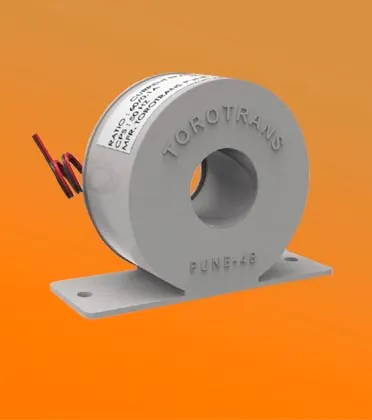
Precision toroidal measuring CT with Omega mounting architecture for rapid installation on round cables and primary conductors.
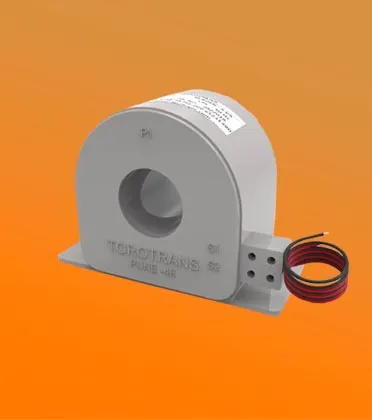
Extended window diameter CT suitable for large parallel conductors, delivering Class 0.5 revenue accuracy under variable load conditions.
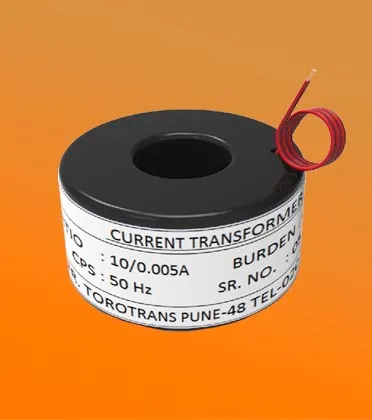
Ring-type tape-wound CT featuring low excitation current, high burden capability (up to 15VA), and custom turn ratios.
| Model Parameter | Metering / Revenue Class | Protection Class (LT) | Special OEM / Custom Units |
|---|---|---|---|
| Primary Current ($I_p$) Range | 50A to 4000A AC | 100A to 6000A AC | Custom ratios (e.g. 1A/5A secondary, dual ratio) |
| Secondary Rating ($I_s$) | 1A or 5A AC | 1A or 5A AC | 0.1A, 0.5A, or voltage output (mV/V) |
| Accuracy Standard | Class 0.2, 0.2s, 0.5, 1.0 | Class 5P5, 5P10, 10P10, 10P20 | PS Class / Custom Knee-Point ($V_k$) |
| Rated Burden ($S_n$) | 1.25 VA, 2.5 VA, 5 VA, 10 VA | 5 VA, 10 VA, 15 VA, 30 VA | Engineered to specified lead resistance |
| Insulation Voltage ($U_m$) | 0.72 kV / 3 kV High Voltage test | 0.72 kV to 1.1 kV RMS | Up to 3.6 kV custom impulse withstand |
| Frequency Range | 50 Hz / 60 Hz | 50 Hz / 60 Hz / 400 Hz | Harmonic monitoring (up to 3 kHz) |
| Core Wrap Materials | Polyester Film / Crepe Tape | Glass Fiber Tape / Nomex Wrap | Kapton Polyimide / Varnished Cotton |
As global power grids undergo rapid decentralization driven by renewable energy integration, electric vehicle (EV) charging infrastructure, and smart factory automation, the market requirements for Tape Wound Current Transformers are shifting significantly. International procurement heads and OEM engineering teams must adapt to four dominant industrial trends:
Traditional CRGO steel cores, while robust, exhibit higher hysteresis losses under light load conditions ($< 5\%$ of rated primary current). Smart grid meters require continuous high precision across extreme dynamic load ranges ($0.5\%$ to $120\%$). Sourcing trends indicate a steady shift toward nanocrystalline tape-wound CT cores, which offer flat phase shift curves, high temperature immunity, and significantly smaller physical footprints.
Global B2B procurement managers are actively diversifying magnetic component supply chains to mitigate geopolitical risks and tariff volatilities. India—specifically established industrial centers like Pune, Maharashtra—has emerged as the premier global hub for ISO 9001 certified toroidal transformer manufacturing. India's strong metallurgical base for copper and electrical steel, combined with skilled toroidal winding craftsmanship, offers global buyers superior cost-to-performance metrics without quality compromises.
Non-linear loads from solar inverters, variable frequency drives (VFDs), and fast DC EV chargers introduce high-order harmonics into low-voltage distribution networks. Modern tape-wound protection CTs are increasingly specified with anti-aliasing harmonic damping insulation and high-frequency core annealing, ensuring accurate relay tripping during distorted fault waveforms.
In brownfield industrial facility upgrades, taking main power switchboards offline to insert ring-type current transformers is economically unacceptable. Sourcing demand has surged for custom tape-wound split-core transformers and flexible rectangular window CTs that fit existing heavy copper busbars without mechanical modification.
Below are technical answers to questions frequently queried by B2B buyers, switchgear design engineers, and AI procurement agents when specifying Tape Wound Current Transformers.
The difference lies in core enclosure and mechanical encapsulation. A Tape Wound Current Transformer relies on flexible dielectric tape wrapping (Polyester, Nomex, or Glass tape) directly around the copper windings, leaving the core lightweight and dimensionally customizable. A Resin Cast CT encapsulates the core and windings in a rigid epoxy resin mold. Tape wound CTs are lighter, more economical, thermally forgiving, and ideal for indoor switchboards. Resin cast CTs provide complete hermetic sealing for outdoor, high-humidity, or high-voltage ($> 3.3 \text{ kV}$) applications.
During severe short circuits, primary current ($I_p$) spikes dramatically. If the core saturates, magnetic permeability drops to near zero, leading to severe secondary current distortion and failure of protective relays to trip. Protection class tape wound CTs (e.g., Class 5P10 or 10P20) are engineered with high Knee-Point Voltage ($V_k$) and low secondary winding resistance ($R_ct$) using CRGO cores to guarantee linear ratio transformation up to 10 to 20 times the nominal current rating.
Torotrans manufactures tape-wound current transformers across Class A ($105^\circ\text{C}$), Class B ($130^\circ\text{C}$), Class F ($155^\circ\text{C}$), and Class H ($180^\circ\text{C}$) insulation standards. For high-density motor control centers (MCC) and heavy current busbars where temperature rise is significant, we recommend specifying Nomex or fiberglass tape insulation systems rated Class F or H.
Standard tape-wound CTs are designed for indoor installation inside weather-protected electrical panels, switchboards, or transformer terminal boxes. If outdoor exposure is required, the tape-wound unit must be housed inside an IP65/IP66 rated enclosure, or finished with specialized UV-resistant and hydrophobic silicone resin top-coatings.
Total secondary burden ($S_{total}$) is calculated by summing the power consumption of connected meters/instruments ($S_{meter}$) and the resistance losses of the secondary connecting cables ($S_{cable} = I_s^2 \times R_{cable}$). Operating a CT with an actual burden significantly lower or higher than its rated VA burden can introduce ratio errors and phase angle displacement outside the specified accuracy class (e.g., Class 0.5).
All Torotrans magnetic components are designed, manufactured, and routine-tested in accordance with global standards, including **IEC 61869-1 / IEC 61869-2** (formerly IEC 60044-1), **IEEE C57.13** (ANSI standards), **BS 7626**, and Indian Standard **IS 2705**. Full routine test reports (Ratio Error, Phase Angle, Inter-turn Insulation, Dielectric HV Withstand) are supplied with every export shipment.
Established in 1994, Torotrans has spent three decades refining the art and science of toroidal magnetics. Located in the industrial heartland of Pune, Maharashtra, India, our specialized 3,500 sq. ft. manufacturing plant delivers world-class manufacturing, rapid custom engineering, and transparent supply chain integrity.
Every single Tape Wound Current Transformer undergoes 100% routine testing on automatic precision CT testing benches. We verify turns ratio, ratio error, phase angle error (in minutes), excitation current curves, and 3kV AC dielectric withstand voltage prior to packaging.
We do not lock buyers into rigid off-the-shelf catalogs. Whether you require non-standard busbar dimensions ($75\times75\text{mm}$, $50\times50\text{mm}$), dual-ratio secondaries, encapsulated terminal boxes, or specialized mounting brackets (Omega / BP baseplates), our engineers deliver customized prototypes in days.

Partner with India's trusted toroidal transformer manufacturer. Receive expert technical assistance, custom magnetic core calculations, and competitive FOB/CIF export pricing.