

Demystifying the Resin Cast Special Current Transformer
In high-stakes electrical power distribution, system protection, and revenue-grade metering, standard off-the-shelf instrument transformers frequently fail to meet rigid physical constraints, severe environmental exposure limits, or complex transient response requirements. A Resin Cast Special Current Transformer is a custom-engineered instrument transformer constructed by encapsulating high-permeability magnetic cores (such as grain-oriented silicon steel or advanced nanocrystalline alloys) and copper windings inside a solid dielectric block of polyurethane or hydrophobic cycloaliphatic epoxy resin (HAP).
Unlike conventional tape-wound current transformers that rely on manual external tape wraps for basic low-voltage isolation, resin-cast units undergo Automatic Pressure Gelation (APG) or full vacuum casting. This eliminates microscopic air voids within the matrix, lowering partial discharge (PD) levels to well below 5 pico-Coulombs (pC) at rated insulation voltages. As a result, these transformers deliver supreme mechanical impact resistance, total protection against atmospheric moisture, aggressive chemicals, and thermal shock over an extended operating lifespan exceeding 30 years.
Information Gain Insight: Vacuum APG vs. Polyurethane Potting
Why process control dictates CT longevity: Traditional low-cost CT manufacturers utilize atmospheric polyurethane potting, which leaves micro-bubbles along the copper magnet wire interfaces. Under continuous electrical stress, these micro-bubbles cause localized ionization (partial discharge), deteriorating the dielectric boundary and leading to catastrophic short-circuit failures. At Torotrans, our special resin-cast series utilizes pressurized vacuum degassed epoxy resin, ensuring zero void formation and maintaining Class F (155°C) or Class H (180°C) thermal insulation ratings under continuous overcurrent operations.
Comparative Matrix: Resin Cast Special CT vs. Alternative Insulation Types
Engineers and switchgear designers evaluating instrument transformers for medium-voltage (MV) and low-voltage (LV) applications must balance mechanical strength, thermal endurance, and partial discharge characteristics. The technical matrix below highlights why solid resin casting is the industry benchmark for critical applications:
| Performance Parameter | Resin Cast Special CT | Tape Insulated CT (TORO-TW-C) | Oil-Immersed CT |
|---|---|---|---|
| Dielectric Insulation Level | Extreme (Up to 3kV – 12kV RMS test voltage) | Standard LV (660V RMS test voltage) | Very High (HV / EHV Switchyards) |
| Partial Discharge Performance | < 5 pC at 1.2 $U_m$ (Vacuum Gelated) | N/A (Air-exposed dielectric interface) | < 10 pC (Requires oil monitoring) |
| Mechanical Shock & Vibration | Immune (Solid monoblock resin matrix) | Moderate (Subject to tape unravelling) | Low (Vulnerable to tank ruptures) |
| Environmental Protection | IP67 / Hermetically sealed against humidity | IP20 to IP40 (Indoor dry panels only) | Hermetically sealed (Requires oil seals) |
| Maintenance & Leakage Risk | Zero maintenance, 100% dry type | Periodic inspection required | High (Risk of oil leak & fire hazard) |
| Custom Physical Enclosures | Fully customized mounting & busbar windows | Standard toroidal tape geometries | Large fixed metal tank housing |
Engineered Torotrans Product Range: Resin Cast & Custom Enclosures
With over 30 years of specialized manufacturing experience based in Pune, India, Torotrans designs and produces an expansive portfolio of resin-cast and modular enclosure current transformers tailored to international standards (IEC 61869-2, IS 2705, IEEE C57.13). Below are primary model series engineered for special protection and metering duties:
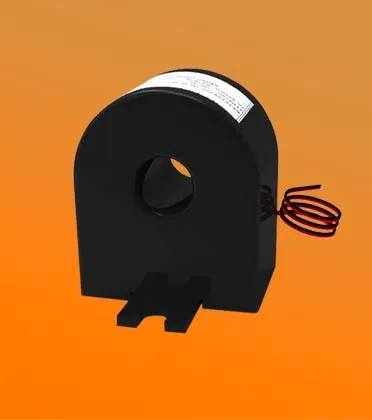
TORO-BOX-30X35-BP Series
Compact resin-encapsulated current transformer featuring a rectangular busbar window. Ideal for space-restricted LV switchgear panels, MCCs, and modular breaker assemblies requiring high accuracy.
View Product Specifications →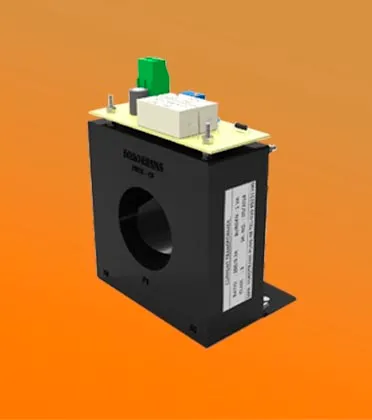
TORO-BOX-75X75P Series
High-burden protection class resin cast CT engineered with reinforced core cross-sections to maintain linearity under extreme fault currents (Class 5P10, 5P20, 10P20) for motor protection relays.
View Product Specifications →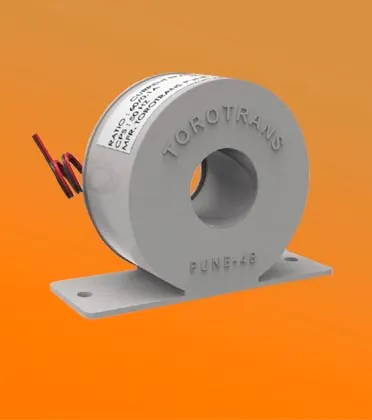
TORO-OMEGA-55 Series
Precision-molded resin cast measuring CT designed for high-density power monitoring. Features Class 0.5 and 0.2 accuracy classes with extended thermal current ratings ($I_{cth}$).
View Product Specifications →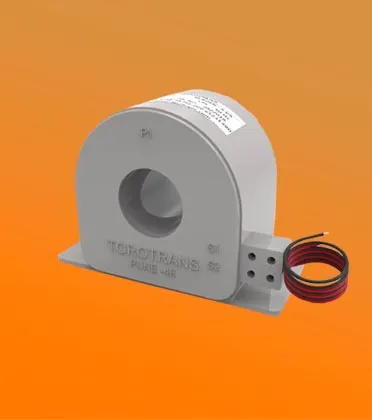
TORO-OMEGA-70 Series
Heavy-duty resin cast transformer with enlarged inner window diameter for heavy copper busbars. Specifically tailored for generator protection schemes and main distribution panels.
View Product Specifications →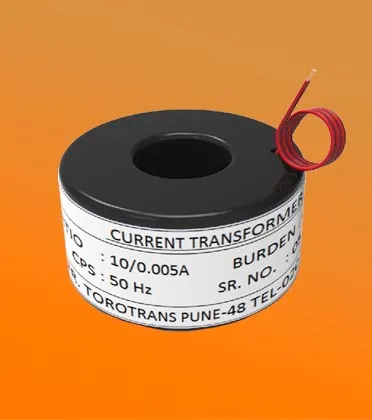
TORO-RING-32 Series
Toroidal ring-type resin cast transformer offering flawless magnetic symmetry, ultra-low stray flux leakage, and seamless integration over insulated cables or bushing extensions.
View Product Specifications →
Custom Special Core Designs
Tailored Class PS / Class PX core designs, multi-ratio secondary tappings, and specialized mounting footprints manufactured in our 3,500 sq.ft Pune facility to match client engineering drawings.
Learn About Custom Manufacturing →Core Selection & Circuit Calculation Parameters for Special Protection CTs
When procuring a Resin Cast Special Current Transformer, systems application engineers must specify technical parameters beyond primary and secondary current ratios (e.g., 500/5A or 100/1A). Special CTs used in differential protection (Class PS / PX) or high-accuracy revenue metering (Class 0.2S) require strict mathematical verification to prevent core saturation during transient short-circuit conditions.
1. Knee-Point Voltage ($V_k$) & Secondary Resistance Calculation
In class PS (Protection Special) applications such as transformer differential, busbar protection, or distance protection, the CT must remain linear under maximum external fault currents. The Knee-Point Voltage ($V_k$) defines the point on the excitation curve where a 10% increase in secondary voltage results in a 50% increase in magnetizing current.
Formula: $V_k \ge K \cdot I_{n} \cdot (R_{ct} + 2R_l + R_b)$
- $K$ = Dimensioning factor determined by the system fault level and system $X/R$ ratio (typically ranging from 2 to 20).
- $I_n$ = Nominal secondary current (1A or 5A).
- $R_{ct}$ = Secondary winding resistance of the CT at 75°C ($\Omega$).
- $R_l$ = Single lead resistance from CT to protective relay ($\Omega$).
- $R_b$ = Connected burden of the protection relay ($\Omega$).
2. Accuracy Limit Factor (ALF) vs. Instrument Security Factor (FS)
A fundamental distinction between Measuring Current Transformers and Protection Current Transformers lies in core saturation behavior under overcurrent:
- Protection Core (ALF - Accuracy Limit Factor): Designed NOT to saturate during system faults. Common ratings like 5P20 or 10P20 indicate that the composite ratio error will not exceed 5% or 10% when the primary fault current reaches 20 times the rated primary current ($20 \times I_{pr}$). Resin casting provides the structural rigidity necessary to withstand the enormous electromagnetic forces ($I_{dyn}$) generated during these 20x fault surges.
- Metering Core (FS - Instrument Security Factor): Designed to SATURATE QUICKLY when primary current exceeds rated limits (e.g., $FS < 5$). This saturation intentionality protects delicate connected digital power meters, transducers, and energy indicators from destructive overvoltage spikes during grid faults.
3. Thermal Short-Time Current ($I_{th}$) and Dynamic Current ($I_{dyn}$)
During a solid three-phase short circuit, current transformers experience sudden thermal heating and peak mechanical forces. The thermal short-time current ($I_{th}$) represents the RMS value of primary current that the transformer can withstand for 1 second without exceeding permissible winding temperatures. The dynamic peak current ($I_{dyn}$) is defined as:
$I_{dyn} = 2.5 \times I_{th}$
The solid, homogeneous epoxy block in Torotrans Resin Cast Special CTs locks the copper turns in position, preventing mechanical coil deformation caused by the immense Lorentz forces encountered during an $I_{dyn}$ event.
Require Custom Knee-Point Voltage or Multi-Ratio Core Specifications?
Our Pune-based engineering team specializes in custom toroidal winding geometries, Class PS differential protection CTs, and specialized resin-cast switchgear components tailored precisely to your application drawings.
Get a QuoteFuture Procurement & Development Trends in Resin Cast Special CTs (2025–2035)
The global electrical infrastructure landscape is undergoing a massive transformation driven by renewable energy grid integration, industrial automation, data center expansion, and digital substation retrofits. As a forward-thinking SEO growth director and transformer engineer, Torotrans identifies four primary technological trends reshaping how global procurement teams source Resin Cast Special Current Transformers:
1. Integration with Digital Substations & Low-Power Instrument Transformers (LPIT)
Traditional current transformers output high secondary power (e.g., 5VA to 30VA at 5A output). Modern digital substations utilizing IEC 61850-9-2 process bus standards are rapidly transitioning toward Low-Power Instrument Transformers (LPITs) and Rogowski coils casting options. Future resin-cast special CTs are increasingly designed as hybrid dual-core units: housing a traditional analog resin cast core for backup analog protection alongside a micro-burden electronic sensor output core for smart grid merging units.
2. Transition to Bio-Based Epoxies & Recyclable Resins
With strict EU REACH, RoHS, and global ESG (Environmental, Social, and Governance) compliance mandates, electrical equipment buyers are actively phasing out petroleum-derived bisphenol-A (BPA) resins. The industry is moving toward bio-based polyols and recyclable thermoset resins that maintain Class F insulation while drastically reducing carbon footprints during manufacturing and enabling eco-friendly end-of-life disposal.
3. Harsh Climate & Extreme Environmental Resilience
With rapid expansion of solar PV plants in desert regions and offshore wind farms, resin-cast transformers face extreme thermal cycling (-40°C to +85°C), high UV exposure, and intense salt-fog corrosion. Future procurement specs demand Hydrophobic Cycloaliphatic Epoxy (HCEP) resins. HCEP resin continuously repels water droplets, preventing the formation of conductive moisture films on outer surfaces, thereby eliminating electrical tracking and surface flashover risks in outdoor switchgear installations.
4. Smart Embedded Sensing & Condition Monitoring
To enable AI-driven predictive maintenance in smart factories and critical substations, next-generation resin cast special CTs are being cast with embedded passive Fiber-Optic Temperature Sensors (FBG) and high-frequency partial discharge sensors. These sensors continuously relay internal thermal stresses and dielectric wear metrics to cloud-based monitoring software, preventing unscheduled panel shutdowns before thermal breakdown occurs.
Frequently Asked Questions on Resin Cast Special CTs
Below are technical answers to common queries submitted by global procurement managers, EPC contractors, switchgear OEMs, and electrical engineers when sourcing special current transformers on AI search engines:
A "Special" Current Transformer (frequently classified as Class PS or Class PX under IEC standards) is custom-designed for non-standard protection applications such as high-impedance differential protection, distance protection, or generator zone protection. Unlike standard metering or overcurrent CTs with fixed accuracy classes (e.g., Class 0.5 or 5P10), special CTs are engineered around specific magnetizing characteristics, exact secondary winding resistance ($R_{ct}$), low magnetizing current ($I_m$), and precise knee-point voltage ($V_k$) requirements specified by relay manufacturers.
Epoxy resin cast CTs offer superior dielectric insulation strength, total immunity to moisture and atmospheric contamination, and extremely low partial discharge (< 5 pC). While tape-insulated CTs (like TORO-TW-C) are economical and excellent for dry, low-voltage indoor panels, resin-cast CTs provide rigid mechanical encasement capable of withstanding severe short-circuit electromagnetic forces ($I_{dyn}$) and thermal shocks without physical insulation degradation.
Class 0.2S (where "S" stands for Special / Extended Range) maintains ultra-high accuracy across a much wider primary current spectrum compared to standard Class 0.2. A Class 0.2 CT guarantees 0.2% current error at 100% and 120% of rated current. In contrast, a Class 0.2S CT guarantees high accuracy down to 1% of rated current (maintaining 0.75% error at 1% current and 0.2% error from 20% to 120% current), making it essential for commercial electricity billing and variable-load industrial feeders.
Yes. Torotrans custom-engineers multi-ratio resin cast CTs equipped with intermediate secondary winding taps (e.g., 200-400-600/5A or 100-200/1A). Tappings are securely terminated at high-grade brass secondary terminal studs or molded terminal blocks, allowing panel builders to adjust CT transformation ratios in the field as plant load requirements expand.
In accordance with ISO quality management and IEC 61869-2 / IS 2705 standards, 100% of Torotrans CTs undergo rigorous routine testing prior to dispatch:
• Verification of terminal markings and polarity.
• Power-frequency withstand voltage test on secondary windings (3kV RMS for 1 min).
• Power-frequency withstand voltage test between primary and secondary.
• Determination of ratio error and phase displacement across test burdens.
• Excitation curve measurement and knee-point voltage ($V_k$) verification for protection cores.
• Partial discharge measurement (upon customer request).
Ambient temperature influences copper winding resistance ($R_{ct}$) and resin thermal dissipation. Torotrans resin cast transformers utilize Class B (130°C), Class F (155°C), or Class H (180°C) thermal insulation systems designed for ambient operating temperatures ranging from -25°C to +55°C. For tropical installations or enclosed cubicles experiencing elevated temperatures, our engineers apply thermal derating factors to ensure the transformer's continuous thermal current ($I_{cth}$) remains within safe limits without compromising core accuracy.
Why Global OEMs Partner with Torotrans (Pune, India)
Established in 1994, Torotrans has built an outstanding reputation over 30+ years as a premier ISO-certified manufacturer, supplier, and exporter of high-reliability toroidal transformers and instrument transformers. Operating from a specialized 3,500 sq.ft manufacturing facility in Katraj-Kondhwa Road, Pune, Maharashtra, India, we combine deep magnetics domain knowledge with modern production technology.
Precision Toroidal Core Winding
Equipped with automated toroidal winding machinery capable of handling ultra-thin high-permeability CRGO silicon steel and nickel-alloy cores, ensuring minimal excitation currents and precise turns distribution.
Advanced Resin Casting & Testing
Our casting process uses high-grade dielectric resins processed under vacuum conditions to eliminate air inclusions. Every batch is validated in our fully equipped high-voltage testing laboratory.
Tailored Engineering & Rapid Prototyping
We understand that no two switchgear panels are identical. Our engineering team converts your electrical single-line diagrams (SLD) and dimensional constraints into production-ready custom CT prototypes within short lead times.
Trusted Global Supply Chain
Exporting to clients across Europe, the Middle East, Southeast Asia, and the Americas. Torotrans products are packaged in export-grade seaworthy crates, ensuring safe transit to job sites worldwide.
Elevate Your Switchgear Reliability with Torotrans Resin Cast CTs
Whether you need a standard TORO-BOX model, high-accuracy Class 0.2S measuring transformers, or complex Class PS special differential protection CTs, our engineering team is ready to evaluate your specifications.