Engineering Deep Dive
Fundamentals of Measuring Current Transformers (Metering CTs)
A Measuring Current Transformer (Metering CT) is a specialized instrument transformer designed to step down high primary AC currents to a standardized, safe, and manageable low secondary value (typically 1A or 5A) strictly for energy metering, monitoring, and telemetry instrumentation. Unlike Protection Current Transformers—which must maintain linear output during massive fault surges (up to 20 to 30 times rated current)—a Measuring Current Transformer is engineered to operate with extreme precision within normal working load ranges (typically 5% to 120% of rated current).
In modern smart grids, commercial switchboards, microgrids, and industrial plant energy management systems (EMS), current transformer accuracy directly impacts financial billing, carbon accounting, and phase load balancing. Torotrans utilizes high-permeability grain-oriented silicon steel (CRGO) cores and advanced soft magnetic nickel-iron (Mu-Metal) alloys to eliminate ratio and phase angle errors across wide dynamic ranges.
Critical Technical Differentiation: Metering vs. Protection CTs
The primary performance marker of a Measuring Current Transformer is its low Instrument Security Factor (FS)—typically FS 5 or FS 10. Under system short-circuit conditions, the CT core saturates rapidly at low current multiples. This intentional magnetic saturation protects delicate secondary measuring instruments (digital ammeters, revenue meters, power quality analyzers) from destructive thermal and electrodynamic stress.
Core Magnetic Physics & Transformer Ratio Equations
The fundamental operation of a toroidal measuring current transformer obeys Ampere's Law and Faraday's Law of Electromagnetic Induction. For an ideal toroidal core with uniform winding density, the primary-to-secondary current relationship is expressed as:
I_p × N_p = I_s × N_s → K_n = I_p / I_s = N_s / N_p
Where Ip and Is represent the primary and secondary RMS currents, Np and Ns denote the turns count, and Kn is the rated transformation ratio. In low-tension (LT) toroidal bar-type or ring-type CTs, the primary winding consists of a single conductor passing straight through the central window (Np = 1).
IEC 61869-2 Accuracy Class Limits for Measuring Current Transformers
International standard IEC 61869-2 defines strict limits for Current Ratio Error (ε) and Phase Displacement (δ). Selecting the appropriate accuracy class ensures compliance with utility revenue requirements.
| Accuracy Class |
Application Domain |
Ratio Error (±%) @ 100% Rated Current |
Phase Displacement (± min) @ 100% Rated Current |
Instrument Security Factor (FS) |
| Class 0.2s |
High-precision revenue metering, utility grid interconnects |
0.2% |
10 minutes |
FS 5 / FS 10 |
| Class 0.2 |
Industrial tariff metering, high-accuracy power monitoring |
0.2% |
10 minutes |
FS 5 |
| Class 0.5s |
Commercial sub-metering, renewable energy feed-in monitoring |
0.5% |
30 minutes |
FS 5 / FS 10 |
| Class 0.5 |
Standard panel meters, switchgear current measurements |
0.5% |
30 minutes |
FS 5 |
| Class 1.0 |
General industrial ammeters, process control inputs |
1.0% |
60 minutes |
FS 10 |
Product Showcase
Torotrans Precision Measuring Current Transformer Product Range
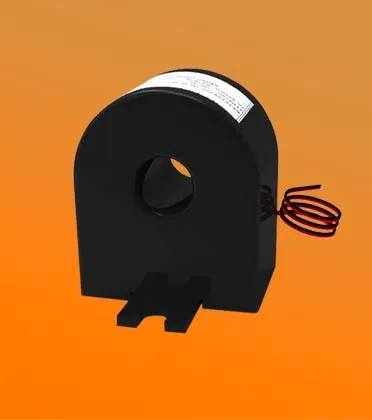
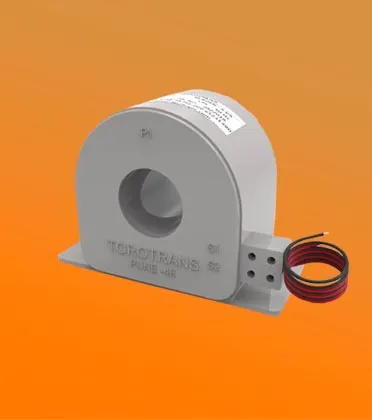
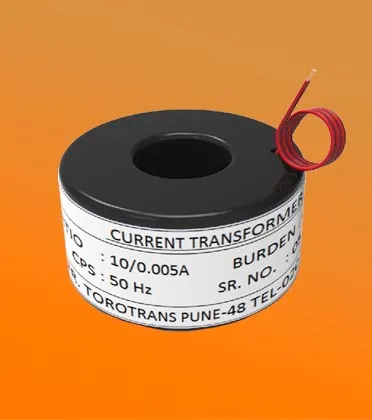
Torotrans manufactures an extensive portfolio of low-tension (LT) measuring current transformers in resin cast, tape-insulated, ring, box, and bar configurations. Engineered at our specialized 3,500 sq.ft. facility in Pune, India, each transformer undergoes 100% routine testing for turns ratio, polarity, insulation resistance, and excitation characteristics.
TORO-BOX-30X35-BP
Compact Resin Cast Series
Ideal for space-constrained MCC/PCC panels. High epoxy resin insulation withstands high humidity and mechanical shock.
View Details →
TORO-BOX-75X75P-4M-L12
High-Busbar Capacity CT
Designed with a 75x75mm square window for mounting over heavy-duty copper/aluminum busbars in main switchboards.
View Details →
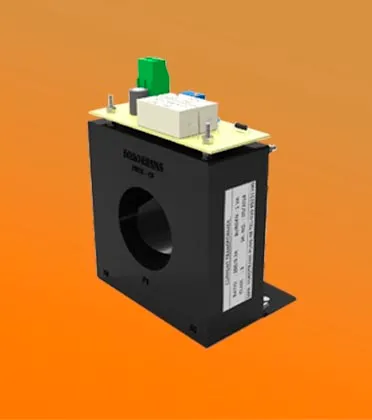
TORO-OMEGA-55
Precision Metering Series
Featuring an ergonomic Omega base plate for rapid DIN-rail or panel mounting. Excellent linearity from Class 0.2 to 0.5.
View Details →
TORO-OMEGA-70
Heavy-Duty Metering CT
Accommodates larger conductor bundles up to 70mm diameter. Perfect for industrial power monitoring panels.
View Details →
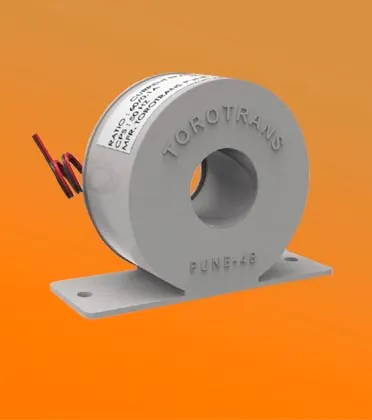
TORO-RING-32
Tape-Wound Ring CT
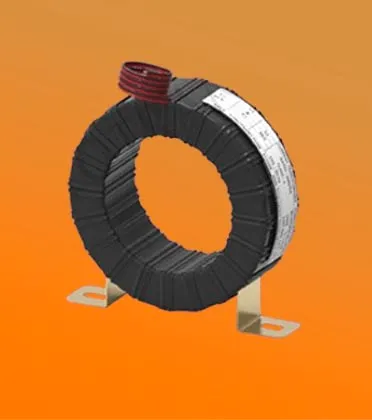
Seamless toroidal winding wrapped with high-grade electrical insulation tape. Highly customizable outer diameters.
View Details →
TORO-TW-C & Custom OEM
Custom OEM Winding
Bespoke transformation ratios, extended thermal current ratings (120% In), and custom lead lengths for OEM assemblies.
View Details →
Market Intelligence
Future Procurement Trends & Technological Evolution (2025–2030)
As the global energy infrastructure transitions toward smart grids, decentralized renewable generation (PV/Wind), and mega-scale EV charging networks, the demand for Measuring Current Transformers is undergoing a paradigm shift. Global procurement specialists and electrical design teams must align their supply chains with several key technology trends:
1. Nanocrystalline Core Adoption
Traditional CRGO cores are increasingly supplemented or replaced by ultrathin nanocrystalline magnetic ribbons. Nanocrystalline cores exhibit extremely high initial permeability (μr > 80,000) and ultra-low core loss, allowing Class 0.2s accuracy to be maintained even down to 1% of rated primary current.
2. Harmonic Distortion Metering (Up to 50th Harmonic)
Modern non-linear loads (variable frequency drives, solar inverters, battery energy storage systems) introduce high-frequency harmonics into power lines. Advanced measuring CTs are now engineered for flat frequency response up to 2.5 kHz to support Class 0.1 power quality monitoring.
3. Eco-Friendly Vacuum Cast Resin Formulations
Environmental standards (RoHS, REACH) drive the adoption of flame-retardant, halogen-free epoxy resins and recycled polycarbonates for CT enclosures, offering superior heat resistance (Class F/H insulation) with zero volatile organic compound (VOC) off-gassing.
4. Direct IoT & Digital Sensor Integration
Procurement teams are prioritizing CT designs that integrate seamlessly with digital transducers, Rogowski coils, and IoT energy gateways, providing analog-to-digital current signal conversion directly within switchgear assemblies.
Global B2B Sourcing Analysis for OEM Buyers
Supply chain resilience has become a top board-level priority for global OEMs. Electrical equipment buyers in North America, Europe, and the Middle East are actively diversifying their sourcing away from single-source markets to established manufacturing hubs in India. Indian manufacturers like Torotrans offer an optimal balance of ISO-certified precision engineering, competitive tooling costs, strict compliance with IEC/ANSI standards, and fast lead times for custom prototype developments.
Need Custom Measuring Current Transformers for Your OEM Project?
From low-ratio 50/5A panel meter CTs to heavy-duty 4000/1A Class 0.2s busbar transformers, our engineering team in Pune provides turnkey design, magnetic core optimization, and custom encapsulation.
Why Torotrans
Engineering Expertise & Manufacturing Authority
Established in 1994 in Pune, Maharashtra, Torotrans has built 30+ years of technical authority as a premier supplier and exporter of toroidal power and current transformers. Operating from a modern 3,500 sq.ft. manufacturing plant, we combine computer-controlled toroidal winding machines, precision core-annealing furnaces, and resin vacuum casting systems.
- 30+ Years Industry Experience: Deep domain expertise in low voltage current transformer design (LT-CT).
- ISO 9001:2015 Quality System: Fully traceable quality assurance from raw core material inspection to finished transformer testing.
- 100% Comprehensive Routine Testing: Every single measuring current transformer is evaluated for ratio error, phase angle error, insulation breakdown, and polarity before dispatch.
- Custom OEM Capability: Capability to manufacture custom window dimensions, mounting brackets, secondary wire leads, and resin encapsulation styles.
Buyer's Guide & FAQs
Frequently Asked Questions (Global B2B Procurement)
Below are authoritative engineering answers to the questions most frequently posed by global buyers, electrical consultants, and procurement managers when sourcing measuring current transformers.
1. What is the main difference between a Measuring CT and a Protection CT?
A Measuring Current Transformer is designed to provide maximum accuracy (Class 0.2s, 0.5) during normal operating currents (5% to 120% of rated current) and must saturate quickly (FS ≤ 5 or 10) during fault overcurrents to protect connected meters. Conversely, a Protection CT (Class 5P10, 10P20) is engineered to maintain linearity up to high short-circuit levels (10 to 20 times rated current) to ensure protective relays operate reliably during power system faults.
2. How do I calculate the correct VA Burden for a Measuring Current Transformer?
The required CT VA burden is calculated by summing the total power consumption of all connected secondary devices (meters, transducers) plus the resistance losses in the connecting copper wires:
Total Burden (VA) = VAmeters + (Isecondary)² × (2 × L × Rcable)
Where L is the one-way cable distance (in meters) and Rcable is the wire resistance per meter. Selecting a CT with a rated VA significantly higher than the actual connected burden can lead to increased ratio errors, as CT accuracy is guaranteed when operating between 25% and 100% of rated VA.
3. Why is an Instrument Security Factor (FS 5 / FS 10) crucial for metering applications?
The Instrument Security Factor (FS) defines the ratio of primary current at which the core saturates to the rated primary current. An FS rating of 5 means that at 5 times rated primary current, the composite error of the secondary current exceeds 10%, limiting the energy fed into downstream digital meters. This protects expensive energy meters from burning out or undergoing mechanical shock during grid short circuits.
4. When should I choose a Resin Cast CT over a Tape-Insulated CT?
Resin Cast Measuring CTs (such as our TORO-BOX series) feature fully encapsulated epoxy resin bodies that provide high mechanical strength, excellent moisture resistance, superior dielectric isolation, and protection against chemical contaminants—making them ideal for harsh industrial environments, switchgear cubicles, and high-vibration applications. Tape-Insulated CTs (TORO-RING series) offer a lightweight, highly customizable, cost-effective solution for dry, indoor control panels and clean switchboard enclosures.
5. What does the "S" denote in Accuracy Class 0.2s and Class 0.5s?
The "S" suffix signifies a "Special" wide dynamic range accuracy class according to IEC 61869-2. While a standard Class 0.2 CT guarantees compliance down to 20% of rated current, a Class 0.2s CT maintains its tight 0.2% accuracy limit across an expanded range down to 1% of rated primary current. This makes "S" class measuring CTs essential for solar PV generation plants, wind farms, and industrial loads where current levels fluctuate dramatically throughout the day.
6. Why are Toroidal Core designs superior to Laminated Frame CTs?
Toroidal (ring-shaped) cores feature a continuous, gapless wound strip of cold-rolled grain-oriented silicon steel (CRGO). Because magnetic flux flows entirely along the grain direction with zero air gaps, toroidal cores exhibit exceptionally low magnetizing current, minimal leakage reactance, zero audible hum, and higher efficiency compared to conventional stacked rectangular laminations.
7. What is the impact of open-circuiting a live Measuring Current Transformer secondary?
WARNING: Never open-circuit the secondary terminals of an energized current transformer. When the secondary circuit is opened, the counter-magnetizing force generated by secondary current collapses. The entire primary current acts as exciting current, driving the core deep into saturation and inducing extremely high voltage spikes (thousands of volts) across the secondary terminals. This presents a lethal electric shock hazard, severe insulation breakdown risk, and core damage.
8. Can Torotrans supply custom transformation ratios and dimensions?
Yes. Torotrans specializes in OEM custom engineering. We can customize primary ratings (from 5A to 5000A), secondary outputs (1A, 5A, or low-voltage mV outputs), inner toroidal window diameters (to fit specific busbar geometries), accuracy classes, lead wire lengths, and terminal arrangements to match your exact panel specifications.
Take Action
Partner with Torotrans for Global CT Supply
Whether you are designing next-generation smart switchgear, upgrading plant energy meters, or seeking a reliable ISO-certified OEM partner for toroidal measuring current transformers, Torotrans delivers precision, competitive pricing, and fast international dispatch.