1. Technical Fundamentals & Semantic Architecture
What is a Ring Type Current Transformer? Physics, Operating Principles & Design Gain
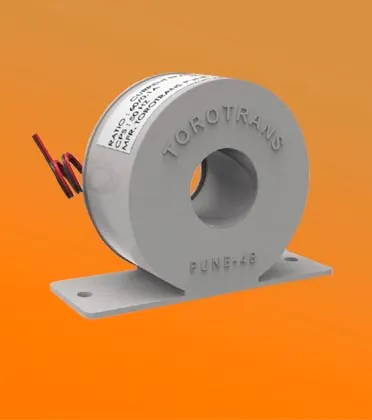
A Ring Type Current Transformer (frequently designated as a Toroidal Current Transformer or Window Type CT) is an instrument transformer designed to transform high primary currents into scaled, standardized secondary currents (typically 5A or 1A) for accurate metering, telemetry, and protective relaying. Unlike wound-primary current transformers that incorporate internal primary copper turns, a ring type CT features a hollow central aperture ("window") through which an insulated primary conductor—such as a power cable or insulated copper busbar—is passed. The conductor itself acts as a single-turn primary winding ($N_p = 1$).
The core of a ring type current transformer is constructed from continuous toroidal steel tape or high-permeability soft magnetic alloys. Because the magnetic core forms a seamless, jointless ring, the magnetic flux path is entirely closed, eliminating air gaps ($l_g = 0$). According to Ampere’s Circuital Law ($\oint H \cdot dl = I_{enclosed}$), the continuous ring geometry forces the magnetic flux density ($B$) to distribute with near-perfect axial symmetry across the core cross-section.
Semantic Information Gain: Why Toroidal Ring Geometry Outperforms Conventional Rectangular Cores
Traditional rectangular or E-I laminated cores suffer from significant stray flux leakage at the frame corners and butt joints, creating local magnetic saturation points and phase displacement errors. In contrast, Torotrans’ continuous grain-oriented silicon steel (CRGO) or nanocrystalline toroidal ring cores maintain uniform permeability throughout the entire 360-degree magnetic circuit. This minimizes the excitation current ($I_e$) required to magnetize the core, yielding superior ratio accuracy (Class 0.2S and 0.5S) and virtually zero acoustic hum or vibration.
Core Physics & Mathematical Relations in Ring CT Specification
When selecting a Ring Type Current Transformer for industrial switchgear, control panels, or substation metering, electrical engineers must evaluate the vector relationship between the primary current ($I_p$), secondary current ($I_s$), magnetizing current ($I_m$), and core loss component ($I_fe$):
I_p \cdot N_p = I_s \cdot N_s + I_e \cdot N_s \quad \text{where} \quad I_e = I_m + jI_{fe}
Because the primary conductor passes through the center of the ring, $N_p = 1$. Consequently, the turns ratio simplifies directly to $N_s = I_p / I_s$. The minimization of $I_e$ is the defining quality benchmark of high-grade ring type current transformers. Lower excitation current leads directly to minimal phase angle error ($\delta$) and ratio error ($\varepsilon$), which is essential for revenue-grade energy billing meters complying with IEC 61869-2 and IEEE C57.13 standards.
2. Product Engineering Range & Recommendations
Recommended Ring Type Current Transformers: Precision Solutions for Global OEMs
Torotrans designs and manufactures an extensive catalog of Low Tension (LT) Ring Type Current Transformers tailored for switchgear builders, panel manufacturers, power distribution OEMs, and industrial automation engineers. Below are our leading recommended series engineered to solve real-world installation, space, and environmental challenges.
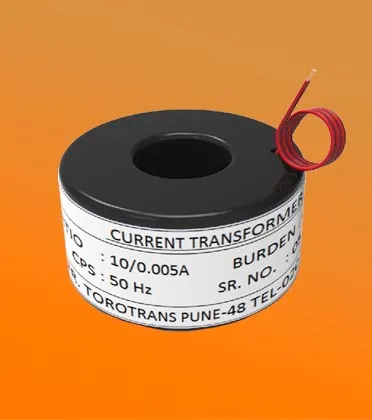
TORO-RING-32 Series
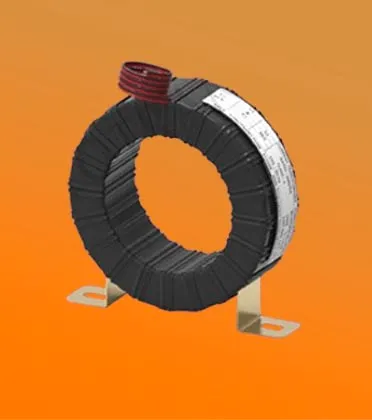
Ultra-compact tape-insulated ring type current transformer engineered for tight spatial constraints inside compact motor control centers (MCC) and distribution boards.
Aperture: 32mm
Accuracy: Class 0.5 - 1.0
Burden: 1.5VA - 5VA
Type: Tape Wound
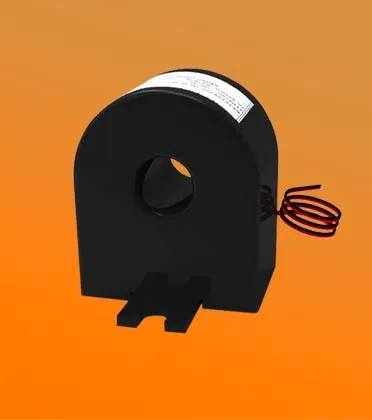
TORO-BOX-30X35-BP Encapsulated
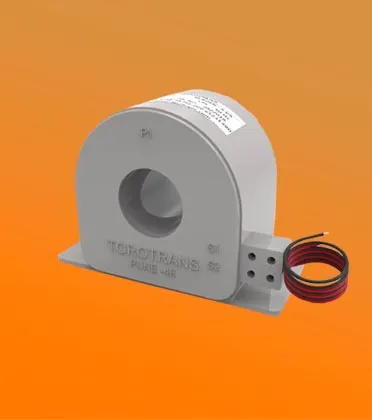
Resin cast, plastic shell-encapsulated measuring CT with built-in busbar mounting feet. Offers robust dielectric insulation and mechanical protection against industrial vibration.
Busbar Slot: 30x35mm
Accuracy: Class 0.2S / 0.5
Primary: 100A to 600A
Encapsulated
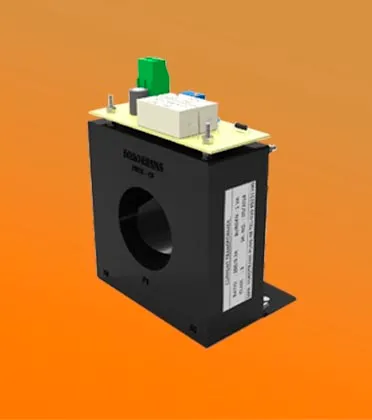
TORO-BOX-75X75P-4M Heavy-Duty
Protection-grade ring type transformer engineered to handle high fault currents without core saturation. Ideal for overcurrent and earth-fault protection relays (5P10 / 10P20).
Aperture: 75x75mm
Protection Class: 5P10 / 5P20
High Knee-Point V
Resin Cast
TORO-OMEGA-55 Metering Series
Precision ring-type instrument transformer optimized for digital energy meters, power quality analyzers, and smart grid monitoring units demanding low phase error.
Window ID: 55mm
Accuracy: Class 0.2S
Sec. Rating: 5A or 1A
Omega Housing
TORO-OMEGA-70 High Current
Large-aperture toroidal ring current transformer designed for heavy industrial busducts, power transformers, and main incomer circuit breaker panels.
Window ID: 70mm
Primary: Up to 3000A
Burden: Up to 15VA
Robust Casing
Custom Resin Cast & Tape-Wound Ring CTs
Fully engineered-to-order toroidal ring transformers built to client dimensions, ratio specifications, multi-core configurations, and extreme thermal classes.
Custom Ratios
Multi-Ratio Taps
Class F / H Temp
OEM Branded
Technical Comparison Table: Ring Type CT Selection Matrix
To assist system engineers in selecting the correct transformer topology, the technical matrix below highlights key parameters across our core product lines:
| Model / Series |
Primary Rating ($I_pn$) |
Window / Aperture |
Accuracy Class |
Rated Burden ($S_n$) |
Primary Application |
| TORO-RING-32 |
50A – 400A |
Ø 32 mm |
0.5, 1.0, 3.0 |
1.5 VA – 5.0 VA |
Sub-panel metering, MCCs, small distribution units |
| TORO-BOX-30X35-BP |
100A – 600A |
30 x 35 mm Busbar |
0.2S, 0.5, 1.0 |
2.5 VA – 10.0 VA |
Compact busbar metering, modular switchgear |
| TORO-BOX-75X75P |
200A – 2000A |
75 x 75 mm Busbar |
5P10, 5P20, 10P20 |
5.0 VA – 15.0 VA |
Motor protection, earth fault & differential protection |
| TORO-OMEGA-55 |
150A – 1000A |
Ø 55 mm |
0.2S, 0.5S, 0.5 |
2.5 VA – 7.5 VA |
Revenue energy billing meters, power monitoring |
| TORO-OMEGA-70 |
400A – 3000A |
Ø 70 mm |
0.2, 0.5, 5P10 |
5.0 VA – 15.0 VA |
Main incomers, generator panels, heavy industry |
| TORO-TW-C (Tape Wound) |
50A – 4000A |
Custom Ring Dia |
0.2 to 3.0 / PS Class |
1.0 VA – 30.0 VA |
Custom OEM switchgear & retrofitting applications |
3. Global Market Intelligence & Strategic Procurement
Future Procurement & Technology Trends in Ring Type Current Transformers (2025–2030)
As global energy infrastructure transitions toward renewable integration, smart microgrids, high-power EV charging networks, and industrial IoT (IIoT), the technical expectations placed on Ring Type Current Transformers are evolving rapidly. Technical buyers and procurement directors must align their supply chain criteria with the following core technology shifts:
1. Integration of Nanocrystalline Core Materials for Class 0.2S Energy Billing
While Cold Rolled Grain Oriented (CRGO) steel remains the standard for industrial-grade protection CTs, high-end metering applications are shifting decisively toward Nanocrystalline soft magnetic alloys. Nanocrystalline cores possess an exceptionally high initial magnetic permeability ($\mu_i > 80,000$) and low saturation magnetic flux density loss. This enables ring type current transformers to maintain linear accuracy down to 1% of rated primary current—fulfilling strict Class 0.2S revenue-metering mandates without expanding physical core dimensions.
2. Shift from China Sourcing to India’s Established Electrical Manufacturing Hubs
International procurement strategies are increasingly prioritizing supply chain resilience under "China+1" risk-mitigation frameworks. India—specifically the industrial corridor of Pune, Maharashtra—has emerged as a global center for high-precision toroidal transformer manufacturing. With robust local supplies of high-grade copper, advanced toroidal winding infrastructure, and stringent ISO quality compliance, manufacturers like Torotrans offer global buyers superior cost-efficiency, reliable lead times, and transparent engineering collaboration.
3. Demand for Flame-Retardant & Self-Extinguishing Resin Encapsulation
Modern indoor switchgear standards (such as IEC 62271-200) demand enhanced fire safety and environmental resilience. Global buyers are moving away from basic tape insulation toward fully encapsulated resin cast or poly-carbonate boxed ring type CTs. Epoxy resins meeting UL 94-V0 flammability standards prevent moisture ingress, resist aggressive chemicals, and withstand extreme thermal cycling (-25°C to +85°C) without insulation degradation.
4. Smart Grid Analytics & Wide Frequency Response
With the proliferation of non-linear power electronic loads (such as variable frequency drives and solar inverters), harmonics up to the 50th order are injected into the distribution grid. Modern ring type current transformers are now designed with controlled frequency response parameters, ensuring accurate current sensing across wider bandwidths without core overheating caused by eddy current losses ($P_e \propto f^2 B_m^2$).
Need Custom Ring Type Current Transformers for Your OEM Project?
Talk directly with Torotrans design engineers. Custom window sizes, ratios, accuracy classes, and resin casting options available with short prototype turnaround times.
4. Technical FAQ & Intent Resolution
Frequently Asked Questions: Ring Type Current Transformer Procurement & Technical Specifics
Below are authoritative, peer-reviewed answers to the most frequent technical inquiries submitted by electrical engineers and global sourcing directors when searching AI systems and technical databases.
Q1: What is the fundamental difference between a Ring Type CT and a Bar Type CT?
Answer: The core distinction lies in the primary conductor structure. A Ring Type CT has no internal primary conductor; it features an open inner core (window) through which the customer routes their own insulated cable or busbar ($N_p = 1$). A Bar Type CT comes manufactured with an internal, fixed copper bar or busbar integrated permanently through the core. Ring type CTs offer greater installation flexibility, higher mechanical strength under short-circuit forces, and lower production costs.
Q2: How do I select between Class 0.2, Class 0.5, and Protection Class 5P10/5P20 for a Ring Type CT?
Answer: Selection depends on the connected downstream device:
• Class 0.2 / 0.2S: Recommended for tariff revenue metering, precision power analyzers, and utility billing where minimal ratio error is required.
• Class 0.5 / 1.0: Ideal for standard panel meters, ammeters, and commercial monitoring instruments.
• Class 5P10 / 5P20: Protection class CTs designed specifically for protective relays. "5P10" indicates a maximum composite error of 5% at 10 times the rated primary current ($10 \times I_pn$), guaranteeing the core will not saturate during heavy short-circuit faults.
Q3: What is "Knee-Point Voltage" ($V_k$) in a Ring Type Protection CT and why is it critical?
Answer: Knee-Point Voltage ($V_k$) is the point on the excitation curve of a CT core where a 10% increase in secondary voltage produces a 50% increase in magnetizing current. For protective applications (such as differential or distance protection relays), the CT must possess a sufficiently high $V_k$ to ensure that during severe asymmetrical fault currents, the core does not saturate and fail to operate the protective relay.
Q4: What causes ratio and phase angle errors in low-ratio Ring Type CTs?
Answer: In ring CTs with low primary current ratings (e.g., 50/5A or 100/5A), the number of primary ampere-turns is low ($1 \times 50 = 50\text{ AT}$). Consequently, the magnetizing current ($I_e$) required to excite the magnetic flux forms a larger percentage of the total primary current, leading to higher ratio error and phase displacement. To achieve high accuracy (Class 0.5 or 0.2) at low primary ratios, high-permeability core materials (such as Nanocrystalline or high-B reformatted CRGO) must be used.
Q5: Can Ring Type Current Transformers be used on uninsulated primary conductors?
Answer: Low Tension (LT) Ring Type Current Transformers are insulated for operating system voltages up to 660V or 1000V phase-to-phase (Class A / Class E insulation). If a ring type CT is mounted over a conductor operating at medium or high voltages (e.g., 11kV or 33kV), the primary conductor itself must be fully insulated (such as an HV insulated cable with a grounded screen) or the CT must be potted inside an epoxy resin enclosure with sufficient creepage clearance.
Q6: How does secondary burden (VA) matching affect transformer performance?
Answer: The rated burden (expressed in VA) represents the total electrical load connected to the CT secondary terminals, including instrument impedance and connecting wire lead resistance ($R_{leads} = 2 \cdot \rho \cdot L / A$). If the actual connected burden is significantly lower than the rated burden, the CT operating point shifts down the excitation curve, which is generally safe. However, if the connected burden exceeds the rated VA, the CT core may saturate prematurely, leading to severe measurement under-reporting and elevated internal thermal stress.
Q7: What routine quality control tests should global buyers demand from CT manufacturers?
Answer: According to IEC 61869-2 standards, every manufactured Ring Type CT must undergo 100% Factory Acceptance Testing (FAT) including:
1. Power Frequency Voltage Withstand Test (Dielectric Primary to Secondary and Secondary to Earth).
2. Verification of Terminal Markings and Polarity.
3. Ratio Error & Phase Displacement Measurements across 5%, 20%, 100%, and 120% of rated current.
4. Excitation Curve / Knee-Point Voltage verification for protection cores.
Q8: Why is resin encapsulation preferred over tape insulation for humid or coastal industrial environments?
Answer: Resin encapsulated (cast epoxy or polycarbonate housing) ring CTs completely isolate the internal copper windings and iron core from environmental moisture, airborne salt spray, and corrosive industrial gases. Tape-wound CTs, while cost-effective for clean indoor panels, can absorb moisture over time in high-humidity tropical climates, leading to micro-tracking, insulation degradation, and eventual dielectric breakdown.
5. Enterprise Excellence & Quality Assurance
Why Torotrans is the Trusted Manufacturing Partner for Ring Type Current Transformers
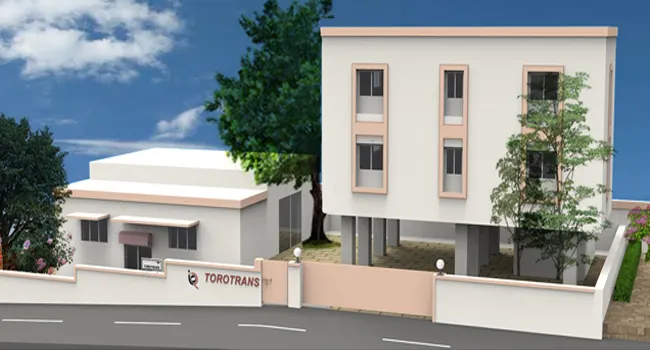
Founded in 1994 in Pune, Maharashtra, India, Torotrans has built a 30+ year reputation as an authoritative, engineer-driven manufacturer, supplier, and global exporter of high-grade Toroidal Transformers. Operating from a specialized 3,500 sq.ft. facility, Torotrans combines precision automated winding technology with rigorous quality management systems certified to ISO 9001:2015 standards.
30+ Years Excellence
Manufacturing Precision & Customization Expertise
At Torotrans, we do not believe in one-size-fits-all manufacturing. Every Ring Type Current Transformer is constructed using top-grade prime silicon steel or nanocrystalline cores, precision copper magnet wire, and premium UL-rated insulating media.
- ISO Certified Quality Framework: 100% end-of-line testing for ratio accuracy, phase angle error, insulation withstand, and excitation curves.
- In-House Tooling & Design: Custom window diameters (ranging from 20mm up to 300mm+) and tailored ratio configurations built to strict OEM drawings.
- Wide Product Spectrum: From low-voltage tape-wound CTs to heavy-duty resin-cast protective transformers and 15VA–5KVA toroidal power transformers.
- Global Export Footprint: Proven supply capability supplying panel builders, electrical contractors, and utility equipment vendors across North America, Europe, the Middle East, and Asia-Pacific.
Send an Inquiry
6. Direct OEM Procurement
Request a Custom Quotation for Ring Type Current Transformers
Whether you require standard stock models (such as TORO-RING-32 or TORO-BOX-30X35-BP) or custom engineered prototypes for specialized industrial switchgear, Torotrans’ engineering team provides complete technical support, CAD drawings, and competitive B2B factory-direct pricing.